
The Canal and Navigable Waterway Engineers 

These engineers played a significant role in the development of the canal system in Britain during the Industrial Revolution. Their innovations helped to transform transportation and infrastructure in the country.


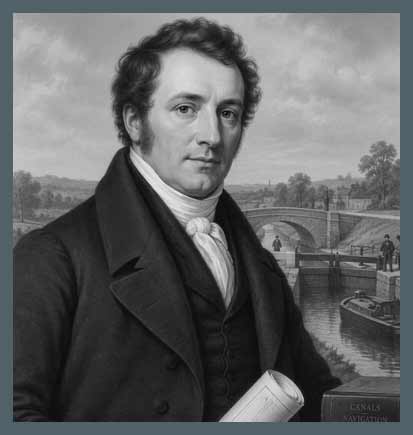
Josias Jessop: A Forgotten Pioneer of Britain’s Canal and Railway Age
While the name William Jessop is firmly established among the greatest engineers of the Industrial Revolution, his son, Josias Jessop, also made a valuable contribution to Britain’s transport infrastructure. As a canal engineer, dock designer and railway surveyor, Josias helped deliver several significant projects during a period when waterways and railways were transforming trade and industry across the country.
Trained directly by his father, he developed into a capable engineer in his own right, contributing to canals, harbours and early railway schemes that supported Britain’s economic expansion. Although his career was relatively short, his work played an important role in connecting industrial communities and improving transportation networks during the early nineteenth century.
Early Life and Family Background
Unlike many professionals of the period, his education focused heavily on practical experience. Accompanying his father on engineering assignments allowed him to develop a detailed understanding of canal construction, dock design and route surveying. This hands-on apprenticeship prepared him for a future career at the forefront of Britain’s transport revolution.
Apprenticeship Under William Jessop
Before establishing himself independently, Josias worked alongside his father on several important infrastructure projects. One of his earliest appointments was on the West India Docks development in London, where he gained experience in large-scale commercial engineering.
He also assisted with plans for the Croydon, Merstham and Godstone Railway. At a time when railways were still in their infancy, the project provided valuable knowledge of route selection, surveying and parliamentary procedures. Josias took an active role in presenting evidence and helping move the scheme forward.
These early assignments allowed him to demonstrate that he possessed both technical ability and leadership qualities, rather than relying solely on his family’s reputation.
The Engineering Challenge of Bristol Harbour
One of the defining achievements of Jessop’s career was his involvement in the construction of Bristol Floating Harbour. This ambitious undertaking sought to improve conditions for shipping by creating a controlled harbour environment less affected by the extreme tidal range of the River Avon.
The project required extensive excavation works, the diversion of river channels and the creation of major dock facilities. During construction, engineers faced significant challenges caused by difficult ground conditions and design modifications. Despite these obstacles, the harbour emerged as one of the most impressive maritime engineering projects of its day.
The success of Bristol Harbour helped establish Jessop’s professional reputation and demonstrated his ability to manage large and complex civil engineering schemes.
A Career as an Independent Engineer
By 1811, Josias Jessop had developed sufficient experience to launch an independent consulting practice. From this point onwards, he became involved in a variety of transport improvement projects throughout Britain, applying the practical principles he had learned from his father while adapting to changing technologies and commercial requirements.
His projects ranged from canal surveys and route planning to railway engineering, reflecting the rapidly evolving nature of transportation during the Industrial Revolution.
Canal Projects and Waterway Development
Wey and Arun Canal Survey
Among Jessop’s significant canal-related works was the survey of a proposed connection between the River Wey Navigation and the River Arun. The objective was to improve inland communications and create more efficient trade routes between London and the south coast.
The project highlighted his expertise in route assessment and his understanding of how waterways could support regional commerce.
Montgomery Canal Western Branch
Jessop was also responsible for surveying and planning the Western Branch of the Montgomery Canal. The scheme was designed to improve transportation links within Wales and neighbouring English counties, making it easier to move agricultural and industrial goods to market.
His involvement demonstrated the continuing importance of canal engineering even as railways began to emerge as a new form of transport.
Contributions to Early Railway Engineering
As Britain entered the railway age, Jessop expanded his expertise beyond canals and docks. He recognised that railways could complement waterways and improve access to areas where canals were impractical or uneconomical to construct.
His engineering work included involvement with the Mansfield and Pinxton Railway, a line designed to support the transportation of coal and other industrial products. He also became associated with the Cromford and High Peak Railway, a pioneering route that crossed challenging upland terrain in Derbyshire.
These projects demonstrated his ability to adapt to emerging technologies and helped place him among the engineers who witnessed the transition from waterways to rail transport.
Most Notable Achievements
- Received direct engineering training from the renowned canal builder William Jessop
- Worked on the development of the West India Docks in London
- Played a major engineering role in the construction of Bristol Floating Harbour
- Surveyed the proposed canal route linking the River Wey Navigation with the River Arun
- Planned the Western Branch of the Montgomery Canal
- Contributed to the development of the Mansfield and Pinxton Railway
- Associated with the surveying and construction of the Cromford and High Peak Railway
- Helped advance Britain’s transition from canal-based transport to integrated rail and canal networks
The Height of His Professional Career
During the 1810’s and early 1820’s, Josias Jessop enjoyed his most productive years as a consulting engineer. His expertise was valued by canal promoters, railway developers and commercial investors seeking to improve transportation efficiency. By successfully working in both canal and railway engineering, he represented a new generation of engineers capable of adapting to changing industrial demands.
His projects helped facilitate the movement of raw materials, finished goods and agricultural produce, contributing to Britain’s growing industrial economy.
Death and Engineering Legacy
Today, he is often overshadowed by the achievements of his father, yet his own accomplishments deserve recognition. Through his work on Bristol Harbour, canal surveys and pioneering railway schemes, he helped improve trade connections and supported the infrastructure that powered the Industrial Revolution.
Conclusion
Josias Jessop was a talented engineer who successfully carried forward the legacy of one of Britain’s greatest canal builders while also embracing the opportunities presented by early railway development. His involvement in major harbour works, strategic canal projects and pioneering railway schemes highlights his importance within the story of Britain’s transport revolution. Although less well known than his father, his engineering achievements remain an important part of the nation’s industrial and waterways heritage.